
Home / Medical Dermatology / Skin Cancer Screenings
Skin Cancer Screenings St. Louis
Skin cancer is the most common cancer in the United States — and one of the most treatable when detected early. A full-body skin exam is the quick, thorough, non-invasive way to catch it early.
Double board-certified
Dermatology and Mohs micrographic surgery
Residency & Fellowship
Cleveland Clinic · Zitelli & Brodland
Physician-owned
Independent practice — never corporate
Established 2020
Serving Troy, Lincoln County, and beyond
What is a Full Body Skin Exam?
A whole-body skin exam is a comprehensive visual evaluation of your skin from head to toe, performed by a board-certified dermatologist or experienced dermatology provider. During the exam, your provider carefully examines your scalp, face and ears, neck and chest, arms and hands, back and abdomen, legs and feet, nails, and areas not typically exposed to the sun.
The goal is to identify new, changing, or unusual lesions that could represent skin cancer or precancerous changes — and just as often, to give you a clear answer that a spot you’ve been wondering about is nothing to worry about.
Why Screenings Matter
Skin cancer often develops silently, without pain or noticeable symptoms in its early stages. Many skin cancers are first detected during routine screenings. Regular skin exams may help:
- Detect skin cancer at an earlier, more treatable stage
- Identify precancerous lesions before they progress
- Monitor existing moles for changes over time
- Provide reassurance and establish a baseline for your skin
What the Exam Looks For
A whole-body skin exam evaluates for all major types of skin cancer, as well as the precancerous changes that can come before them.
Basal Cell Carcinoma (BCC)
The most common form of skin cancer. It often appears as a pearly bump, a non-healing sore, or a pink patch. BCC grows slowly but can cause local tissue damage if left untreated — which is exactly why early detection makes treatment simpler.
Squamous Cell Carcinoma (SCC)
The second most common type. It may appear as a scaly patch, a firm red bump, or a crusted lesion, and it can grow more quickly than basal cell carcinoma. Found early, SCC is typically very treatable.
Melanoma
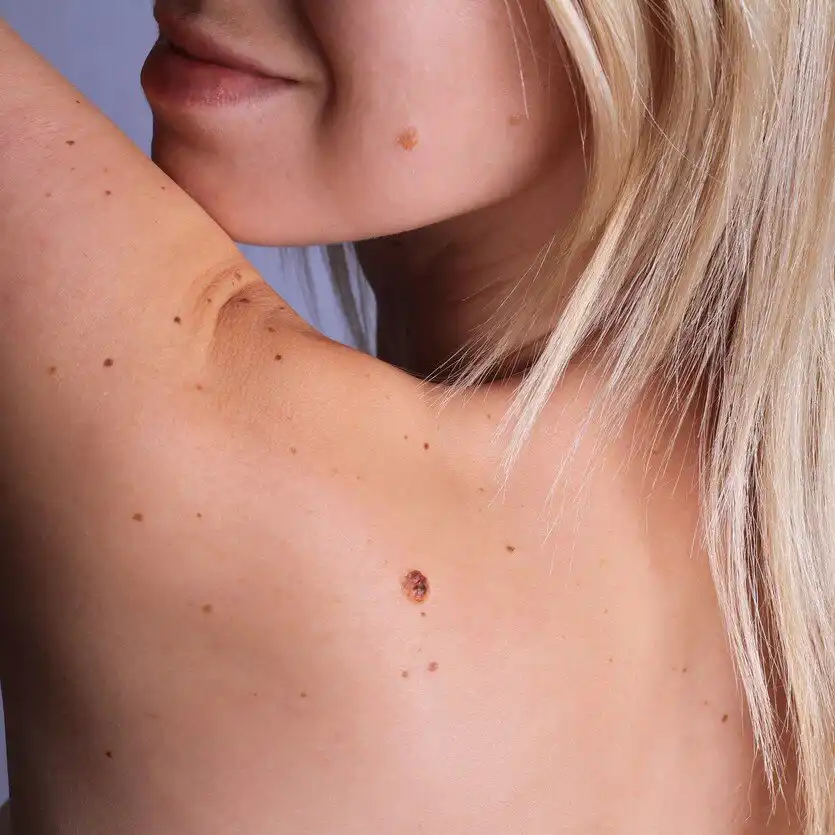
Less common but more serious. Melanoma often develops in or near an existing mole and can spread if not detected early — which is why monitoring moles over time is a central part of every exam.
Precancerous Changes
Actinic keratoses — rough, scaly patches caused by years of sun exposure — can develop into squamous cell carcinoma over time. Identifying and treating them early is one of the most valuable things a routine screening can do.
What to Expect During Your Screening
A whole-body skin exam is quick, thorough, and non-invasive. During your visit:
- You’ll change into a gown for full skin access
- Your provider will examine your skin systematically, head to toe
- Special tools, such as a dermatoscope, may be used for a closer look
- Any areas of interest will be documented and discussed with you
- If needed, a biopsy may be recommended — a quick in-office procedure under local anesthesia
How Often Should You Have a Skin Exam?
For many adults, an annual skin cancer screening is appropriate. Your provider may recommend yearly exams for average-risk patients, more frequent exams for higher-risk individuals — such as those with a personal or family history of skin cancer, many moles, or significant sun exposure — and ongoing monitoring of specific moles or lesions between visits.
If Something is Found
Most spots checked during a screening turn out to be benign. If your provider does find something concerning, the next step is usually a small biopsy, reviewed by a pathologist — and you’ll get a clear explanation of the results and what they mean.
If a skin cancer is confirmed, treatment depends on its type, size, and location, and many early skin cancers are treated with straightforward in-office procedures. For skin cancers on the face or in other areas where sparing healthy tissue matters most, Dr. Brandon T. Beal performs Mohs micrographic surgery right here in our practice — he is double board-certified in dermatology and Mohs surgery and fellowship-trained at Zitelli & Brodland. Being screened here means that if something is ever found, you are already in the care of the team that can treat it.
Schedule a Full Body Skin Exam in Troy, MO
If it has been a year or longer since your last skin cancer screening — or if you’ve noticed a new or changing spot — a professional evaluation is a simple, proactive next step. From our office in Troy, we provide unhurried, careful skin exams for patients across Lincoln County and the surrounding area, including Winfield and Wentzville — and our second location in Chesterfield. Call (314) 834-1400 or request an appointment online.
Common questions
Skin cancer screening FAQs.
Does insurance cover skin cancer screenings?
Skin exams performed for medical reasons are typically covered. We accept Medicare and most major private insurance plans. Your exact cost depends on your plan and deductible — call our Troy office at (314) 834-1400 with specific coverage questions.
What should I watch for between exams?
The ABCDEs of melanoma are a useful guide for moles: Asymmetry, irregular Borders, more than one Color, Diameter larger than a pencil eraser, and Evolving — any change in size, shape, or color. Also worth a look: any new spot, a sore that doesn’t heal, or a spot that itches, bleeds, or feels different from the rest. None of these means a spot is cancerous — they simply mean it’s worth showing your provider.
Will I need a biopsy?
Only if your provider finds a spot that warrants one — most screenings end with reassurance, not procedures. If a biopsy is recommended, it is a quick in-office procedure under local anesthesia, and the sample is reviewed by a pathologist before any further treatment is discussed.
How long does a skin exam take?
Most screenings are completed in a single short visit. The exam itself is visual and non-invasive — no preparation is needed, though it helps to arrive without makeup or nail polish so your provider can see your skin and nails clearly.
I found a spot I’m worried about. Should I wait for my annual exam?
No — a new or changing spot is worth an appointment whenever you notice it. Most new patients are seen within the same week, and an evaluation can either give you peace of mind or catch something early, when it is most treatable. You can also have a specific mole evaluated at the same visit.
When was your last skin check?
A short, simple visit for lasting peace of mind. Same-week appointments. Medicare accepted. Troy, MO — and Chesterfield now open.