
Melanoma is the most serious form of skin cancer, but if caught early, it’s highly treatable. Know the ABCDE warning signs and what melanoma can look like.
Skin cancer is the most common cancer in the United States, and melanoma — while not the most common type — is the most serious. Caught early, melanoma is highly treatable. Caught late, it can spread beyond the skin and become life-threatening. Knowing what to look for and when to take action can make a meaningful difference.


What Is Melanoma?
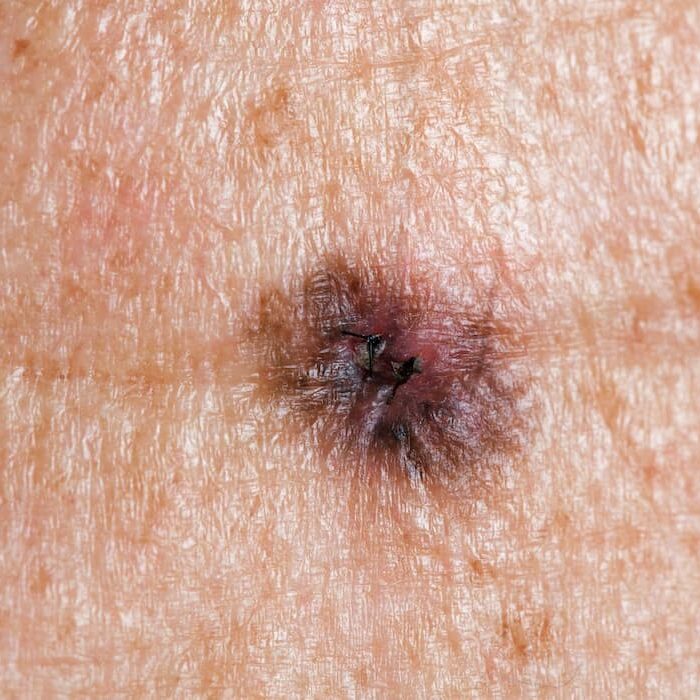
Melanoma develops in the melanocytes, the cells responsible for producing pigment in your skin. It most often appears as a new or changing spot on the skin — a mole that looks different from the others, or a dark lesion that wasn’t there before. It can occur anywhere on the body, including areas rarely exposed to the sun.
While UV exposure is the best-known risk factor, melanoma can also develop in people with darker skin tones, in areas such as the palms, soles of the feet, or under the nails, and in people who have never had a significant sunburn. No one is without risk.
The ABCDEs of Melanoma
Dermatologists use a straightforward framework to help identify suspicious lesions. If you notice any of the following in a mole or skin spot, it warrants professional evaluation.
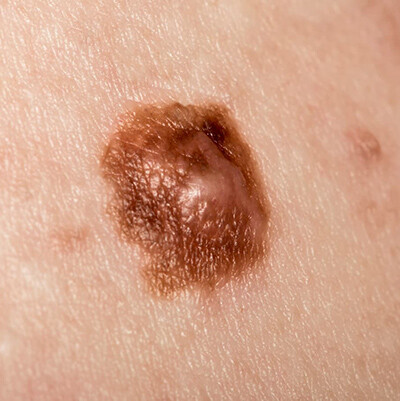
- A — Asymmetry: One half doesn’t match the other. Benign moles are typically symmetrical.
- B — Border: The edges are irregular, ragged, notched, or blurred rather than smooth and well-defined.
- C — Color: Multiple shades of brown, black, red, white, or blue within a single lesion is a warning sign. Uniform color is generally reassuring.
- D — Diameter: Any spot larger than 6 millimeters — roughly the size of a pencil eraser — deserves attention, though melanomas can be smaller when detected early.
- E — Evolving: This may be the most important one. Any mole or lesion that is changing in size, shape, color, or texture — or that begins to bleed, itch, or crust — should be evaluated promptly.
A mole that checks even one of these boxes is worth having looked at. You do not need to check all five.
What Melanoma Can Look Like
Not every melanoma looks like a dark, irregular mole. Some appear as a pink or skin-colored growth, a new lesion that doesn’t heal, or a spot that feels different from surrounding skin. There is also a subtype called amelanotic melanoma that contains little to no pigment, making it much harder to identify without a trained eye.
This is one reason annual skin exams matter — many of the most serious lesions are ones patients had written off as unremarkable.
When to Act
If you notice a spot that is changing, asymmetrical, multi-colored, or simply looks different from your other moles — what dermatologists call the “ugly duckling sign” — schedule an evaluation. You do not need to wait for your annual exam.
Equally important: do not attempt to monitor a suspicious lesion on your own over several months. Early-stage melanoma is highly treatable with straightforward surgical excision. Advanced-stage melanoma requires significantly more intervention. Time matters.
Schedule a Skin Exam in Troy, MO
If something on your skin has changed — or if it has simply been a while since your last full-body skin check — St. Louis Dermatology & Cosmetic Surgery is here to help. Dr. Brandon T. Beal is double board-certified in dermatology and Mohs micrographic surgery, with fellowship training in dermatologic oncology. He sees patients in Troy, Missouri, and surrounding areas, including Moscow Mills, Winfield, and Wentzville.
Early detection starts with a conversation. Call our office at (314) 834-1400 or request an appointment online. A consultation is required prior to treatment. Results and recommendations vary by individual.
Frequently Asked Questions
Yes. Melanoma can arise within an existing mole or appear as an entirely new lesion. Any mole that begins to change after years of stability should be evaluated.
Yes. Dermoscopy can help a trained provider assess a lesion more closely, but a skin biopsy is the only definitive way to diagnose or rule out melanoma.
Lighter skin tones carry a statistically higher risk, but melanoma occurs across all skin tones. In people with darker skin, it is more likely to appear in less visible locations — which is why skin exams matter regardless of complexion.
Once a year is a reasonable baseline for most adults. Those with a personal or family history of skin cancer, atypical moles, or significant lifetime sun exposure may benefit from more frequent monitoring.
GET IN TOUCH